
Your list is empty, add products to the list to send a request










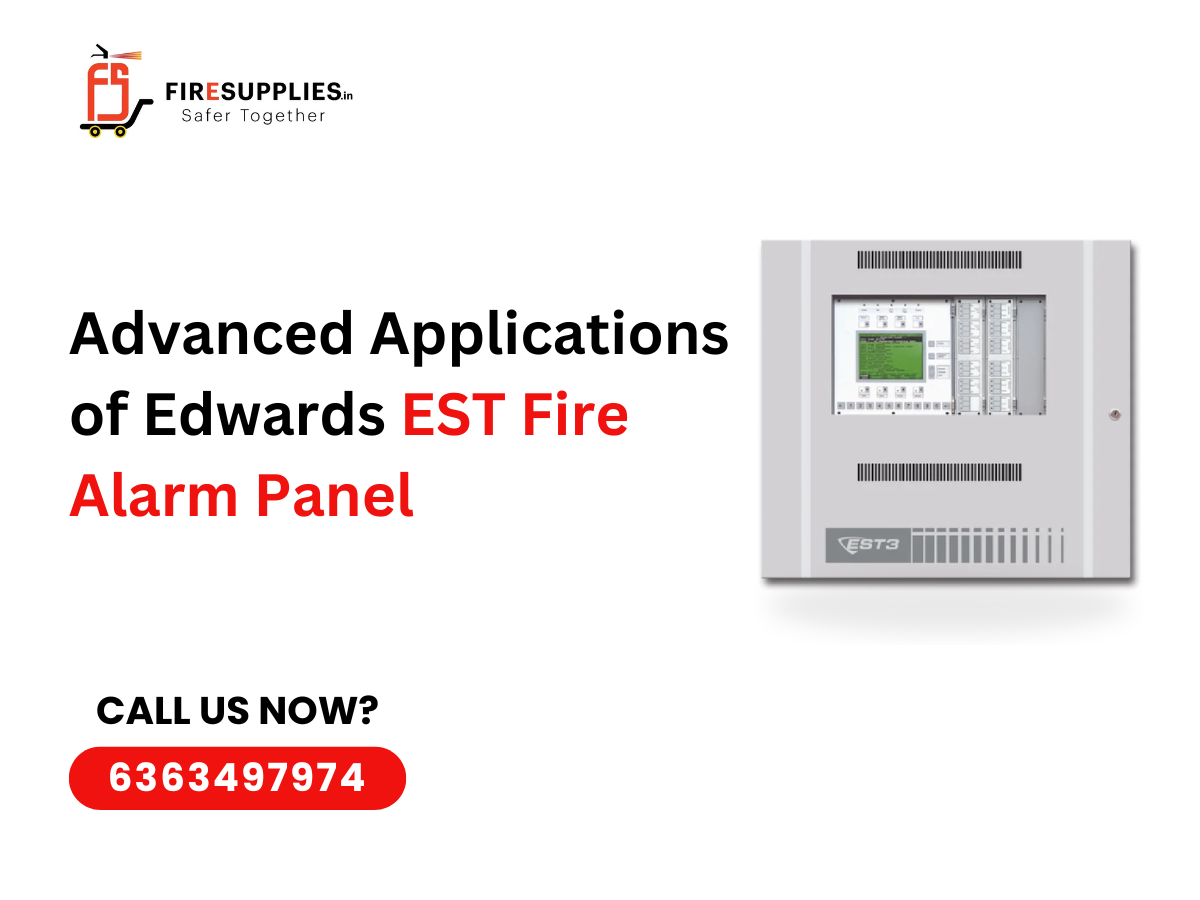
Advanced Applications of Edwards EST Fire Alarm Panel

12
Sep
Fire safety is no longer limited to ringing alarms and flashing lights. Today’s buildings demand intelligent, integrated, and adaptable fire detection systems that not only detect danger but also support advanced building operations. That’s exactly where the Edwards EST fire alarm panel excels.
In this article, you’ll discover the advanced applications of EST fire alarm panel systems, from coordinating evacuation routes to integrating with smart building technologies. By the end, you’ll see why the Edwards EST line is more than just a fire detection system—it’s a central nervous system for modern safety.
Understanding the Edwards EST Fire Alarm Panel
Before diving into its advanced applications, it’s worth revisiting what makes the EST panel unique.
Unlike conventional fire systems that operate on a zone basis, the Edwards EST fire alarm panel is an addressable system. This means each device—detector, call point, or module—communicates directly with the panel, providing pinpoint accuracy during fire events.
Key features that support advanced applications include:
- Expandable architecture (e.g., the CAB5 expandable from 3 to 4 loops).
- Programmable logic for custom fire response sequences.
- Integration capability with HVAC, access control, and elevators.
- Event logging and data analytics for smarter fire management.
Advanced Applications of EST Fire Alarm Panel
1. Coordinated Evacuation Management
One of the most advanced applications of EST fire alarm panel technology is its ability to coordinate evacuation strategies.
Instead of triggering a building-wide evacuation, the panel can:
- Direct occupants floor by floor to reduce congestion.
- Guide people toward safe routes using voice alarms and digital signage.
- Integrate with smart lighting systems to illuminate escape paths.
This approach reduces panic, improves flow, and ensures faster, safer evacuations in high-occupancy buildings like hospitals, airports, and universities.
2. Integration with Smart Building Technologies
Modern facilities are increasingly adopting smart building ecosystems. The EST fire alarm panel integrates seamlessly with these systems, including:
- Building Management Systems (BMS) for real-time monitoring.
- Smart HVAC systems to manage smoke control automatically.
- Access control systems to unlock fire exits.
- IoT-based monitoring tools for remote visibility.
This integration ensures that fire safety doesn’t operate in isolation but as part of a broader intelligent building infrastructure.
3. Programmable Alarm Scenarios
Traditional fire systems provide little flexibility. By contrast, the EST panel allows custom programming of alarm scenarios based on the building’s needs.
Examples include:
- Triggering sprinklers in specific zones without activating the entire system.
- Sending alerts to security teams while initiating partial evacuations.
- Activating voice alarms in multiple languages for diverse occupants.
This level of control is critical in complex environments like research labs or industrial facilities where a one-size-fits-all response isn’t suitable.
4. Multi-System Interoperability
Another advanced application of EST fire alarm panel systems is interoperability.
The panel can work alongside other safety and security systems to provide a holistic response. For instance:
- If a fire is detected, the panel can command CCTV systems to focus on the affected area.
- It can synchronise with public address systems to give live evacuation instructions.
- It can coordinate with gas suppression systems in data centres.
This interoperability maximises situational awareness and enhances response times.
5. Data Analytics for Fire Prevention
The Edwards EST panel does more than respond to alarms—it also collects data logs.
Facility managers can use this data to:
- Track recurring fault patterns.
- Predict areas at higher risk of false alarms.
- Identify maintenance needs before failures occur.
By using these analytics, the EST system transforms from a reactive tool into a proactive safety solution.
6. Flexible Scalability for Growing Facilities
Large-scale projects evolve over time. The EST CAB5 panel is designed to scale with these changes.
- Initially supports 3 loops, expandable to 4 loops.
- Allows seamless addition of devices as buildings expand.
- Can be networked with other panels for unified control.
This flexibility makes the EST system ideal for universities, hospitals, and corporate campuses that grow incrementally.
7. Voice Alarm and Mass Notification Systems
In addition to alarms and strobes, the EST panel supports voice evacuation systems.
Voice instructions are clearer and reduce confusion compared to standard alarms. Messages can be:
- Pre-recorded for specific emergency scenarios.
- Live broadcasted by safety personnel.
- Delivered in multiple languages if required.
This is particularly useful in airports, shopping malls, and hotels where occupants may speak different languages.
8. High-Risk Environment Adaptability
The applications of EST fire alarm panel extend to specialised environments such as:
- Hospitals – selective evacuation to avoid moving critical patients unnecessarily.
- Data centres – integration with gas suppression to protect sensitive servers.
- Industrial plants – custom alarm logic to avoid triggering hazardous chain reactions.
The panel’s adaptability ensures each industry gets a tailored solution.
EST Fire Alarm Panel in Action: Real-World Scenarios
To understand how these applications play out, here are a few scenarios:
- Airport terminal: EST panels coordinate staged evacuation, keeping terminals calm while guiding passengers efficiently.
- Corporate campus: Integrated with access control, the system unlocks doors for safe exit while simultaneously notifying emergency teams.
- University: Multi-panel networking provides unified monitoring across multiple buildings.
These real-world uses show how versatile the EST system is in different environments.
Frequently Asked Questions
1. Can the EST system coordinate evacuation routes during fire events?
Yes. The EST fire alarm panel supports staged evacuation strategies, guiding occupants floor by floor and integrating with smart lighting or voice alarms to provide clear exit instructions.
2. Are custom alarm scenarios programmable on the EST panel?
Absolutely. The panel allows custom programming so you can design alarm responses for specific building needs, such as partial evacuations, multilingual announcements, or selective sprinkler activation.
3. Does the EST support integration with smart building technologies?
Yes. The EST panel integrates with BMS, HVAC, access control, and IoT-based systems, making it an essential part of modern smart building infrastructure.
Final Thoughts
The applications of EST fire alarm panel technology go far beyond traditional fire detection. From coordinating evacuation routes to integrating with smart building systems, Edwards EST panels provide intelligent, flexible, and scalable solutions for modern safety challenges.
If you’re planning a new installation or upgrading your fire system, investing in EST technology ensures you’re prepared not just for compliance, but for the future of fire safety.
Explore the Edwards EST3 CAB5 Fire Alarm Panel (Expandable up to 4 Loops) today and take the next step in protecting your facility with advanced fire safety solutions.

