
Your list is empty, add products to the list to send a request








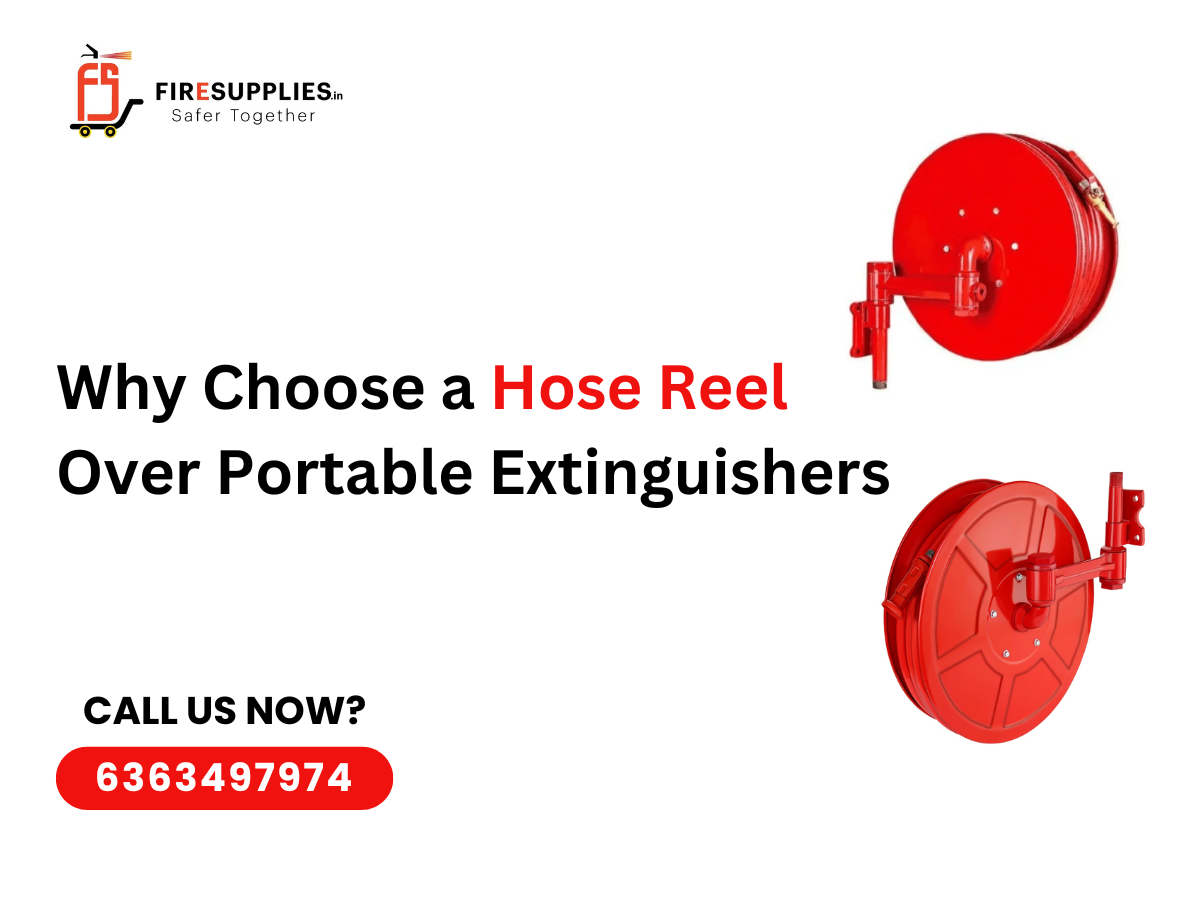
Why Choose a Hose Reel Over Portable Extinguishers

09
Jan
A hose reel plays a vital role in modern fire safety systems, especially in commercial and high-occupancy buildings.
While portable extinguishers are common, they have limits when a fire grows beyond the initial stage.
Choosing a hose reel provides a continuous water supply, wider coverage, and easier operation during emergencies.
This article explains why hose reels are often preferred over portable extinguishers and how they strengthen overall fire protection.
What Is a Hose Reel?
A hose reel is a fixed fire-fighting system that delivers a continuous flow of water through a semi-rigid hose connected directly to a building’s water supply.
It allows occupants to control or suppress fires for a longer duration compared to portable extinguishers.
Hose reels are designed for quick access, simple use, and consistent performance.
Technical Details of a Hose Reel
| Technical Feature | Description |
| Hose Type | Semi-rigid or reinforced rubber |
| Hose Length | Designed for floor-wide coverage |
| Mounting | Wall-mounted or swing-arm |
| Water Supply | Connected to hydrant or pressurised line |
| Operating Pressure | Balanced for manual operation |
| Nozzle | Adjustable spray or jet pattern |
These technical characteristics make a hose reel suitable for sustained fire control.
Understanding Portable Fire Extinguishers
Portable extinguishers are compact fire-fighting devices.
They are designed for quick response to very small fires.
Once discharged, an extinguisher cannot be reused immediately.
This limitation becomes critical if the fire continues to grow.
Hose Reel vs Portable Extinguishers: Core Differences
The biggest difference lies in duration and coverage.
A hose reel supplies water continuously, while extinguishers empty quickly.
Extinguishers are portable and flexible.
Hose reels provide stable, long-term fire suppression.
Both systems have value, but their roles differ significantly.
Applications of Hose Reels
Hose reels are ideal for environments where fires may spread rapidly.
Common applications include:
- Commercial buildings and offices
- Shopping centres and malls
- Hospitals and educational institutions
- Warehouses and factories
- High-rise residential buildings
In these settings, a hose reel offers better fire control than portable extinguishers alone.
Why Hose Reels Are More Effective for Larger Fires
Portable extinguishers are limited by size and discharge time.
They are effective only at the earliest stage of a fire.
A hose reel allows continuous application of water.
This makes it suitable for controlling flames until firefighters arrive.
Advantages of Choosing a Hose Reel Over Portable Extinguishers
Continuous Water Supply
Hose reels do not run out quickly.
Wider Coverage Area
Long hoses reach across large spaces.
Ease of Operation
Simple pull-and-spray mechanism.
Lower Risk of Panic
Steady water flow provides confidence during emergencies.
These benefits make a hose reel a dependable fire safety solution.
Limitations of Hose Reels
Despite their advantages, hose reels have limitations.
- Not suitable for live electrical fires
- Requires adequate water pressure
- Fixed location reduces mobility
- Needs proper installation and signage
Understanding these limitations helps use the hose reel safely and effectively.
When Portable Extinguishers Still Matter
Portable extinguishers are still essential.
They are ideal for quick response to small fires.
Most fire safety designs use both systems together.
This layered approach ensures flexibility and reliability.
Hose Reels in High-Rise Buildings
High-rise buildings require sustained fire-fighting capability.
Portable extinguishers alone are not sufficient.
A hose reel supports internal fire response on every floor.
It helps control fires during evacuation and before fire services arrive.
Electrical Fire Considerations
Water should never be used on live electrical fires.
This applies to hose reels as well.
However, once power is isolated, a hose reel can be used safely.
Proper training ensures correct decision-making during emergencies.
Buying Guide: Choosing the Right Hose Reel
Before selecting a hose reel, consider:
- Building size and occupancy
- Required hose length
- Mounting location and accessibility
- Water pressure availability
- Compliance with fire safety standards
The right hose reel ensures effective and compliant fire protection.
Installation and Maintenance Factors
Professional installation ensures correct pressure and coverage.
Improper installation reduces effectiveness.
Regular inspections check hose condition, nozzle operation, and water flow.
A well-maintained hose reel performs reliably during emergencies.
Training and Safety Awareness
While hose reels are simple, basic training is essential.
Users should know when to use a hose reel and when to evacuate.
Training covers:
- Hose deployment
- Nozzle control
- Safe distance from flames
- Coordination with evacuation procedures
Proper awareness maximises the effectiveness of a hose reel.
Standards for Hose Reels
Hose reels should comply with recognised fire safety standards.
Guidance typically comes from:
- Bureau of Indian Standards (BIS)
- National fire safety regulations
- International fire protection organisations
Certified hose reel systems ensure reliability, durability, and legal compliance.
Frequently Asked Questions
FAQ 1: Do hose reels work on electrical fires?
Hose reels should not be used on live electrical fires unless the power supply is isolated.
FAQ 2: What pressure rating is required for a standard hose reel?
Hose reels are designed to operate at pressures suitable for manual handling and effective water flow.
FAQ 3: Are hose reels suitable for high-rises?
Yes. Hose reels are commonly installed in high-rise buildings for sustained internal fire control.
FAQ 4: Can hose reels replace extinguishers?
No. Both systems work best together.
FAQ 5: Are hose reels difficult to operate?
No. They are designed for simple operation.
FAQ 6: Do hose reels require pumps?
They rely on the building’s pressurised water system.
FAQ 7: How often should hose reels be inspected?
Regular visual checks and scheduled professional inspections are recommended.
FAQ 8: Can hose reels be retrofitted into existing buildings?
Yes, with proper plumbing and layout planning.
Final Call to Action
Fire safety decisions should be based on effectiveness, not convenience alone.
A properly installed hose reel offers dependable fire protection when every second counts.
Explore certified hose reel systems today and strengthen your building’s fire safety strategy.

