
Your list is empty, add products to the list to send a request









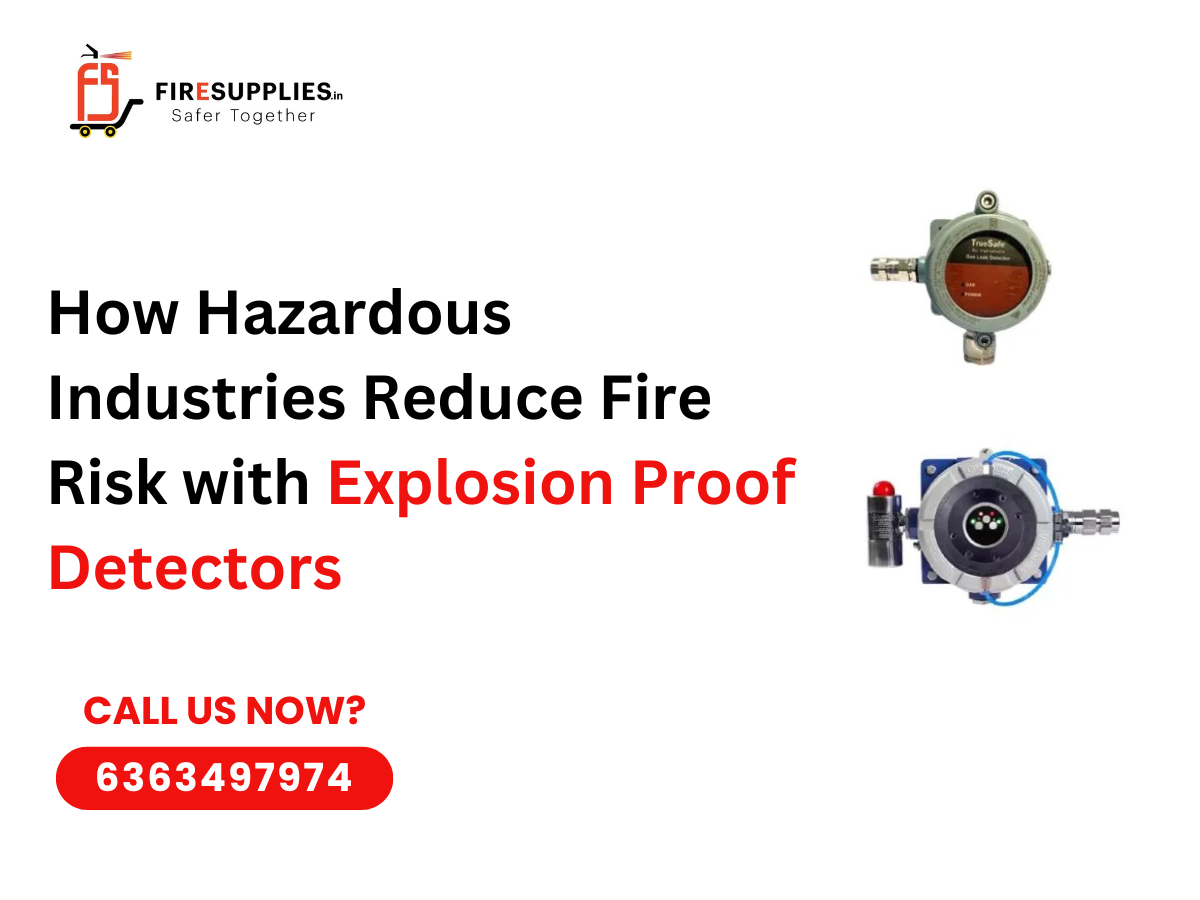
How Hazardous Industries Reduce Fire Risk with Explosion Proof Detectors

18
Apr
In environments where flammable gases, vapours, dust, or combustible materials are present, a single spark can trigger a catastrophic event. How hazardous industries reduce fire risk with explosion proof detectors is one of the most critical questions in industrial safety today. These specialised fire safety products are designed to operate safely in volatile atmospheres — detecting danger before it becomes disaster, without themselves becoming an ignition source.
What Are Explosion Proof Detectors?
An explosion proof detector is a fire or gas detection device engineered to function safely in hazardous areas where explosive atmospheres may exist. Unlike standard fire alarms, these units are housed in robust, sealed enclosures that prevent any internal spark or heat from igniting the surrounding atmosphere. They are a core component of industrial fire safety systems and are mandated by safety regulations across sectors such as oil and gas, chemical processing, mining, and pharmaceuticals.
Technical Specifications: Explosion Proof Detectors at a Glance
| Feature | Details |
|---|---|
| Detection Methods | Infrared (IR), UV/IR flame, catalytic bead, electrochemical, photoelectric |
| Hazardous Zone Rating | Zone 0, Zone 1, Zone 2 (gas/vapour); Zone 20, 21, 22 (dust) |
| Housing Material | Cast aluminium, stainless steel, GRP (Glass Reinforced Plastic) |
| Operating Temperature | -55°C to +75°C (varies by model) |
| Response Time | < 3 seconds (flame detectors); < 30 seconds (gas detectors) |
| Communication Protocols | 4–20mA analogue, HART, Modbus, Foundation Fieldbus |
| Certification Standards | ATEX, IECEx, UL, FM, SIL 2/3 |
| Loop Compatibility | Expandable addressable loops (up to 250 devices per loop) |
| Multi-Panel Sync | Yes — supports high-bandwidth, multi-panel synchronisation |
| Power Supply | 24V DC (standard); intrinsically safe barriers available |
| Ingress Protection | IP66, IP67, IP68 |
This level of engineering makes explosion proof gas detectors far superior to standard smoke or heat detectors in volatile environments. They form the backbone of any serious fire alarm system for industrial use.
Where Are Explosion Proof Detectors Used? Key Applications
The need for hazardous area fire detection spans a wide range of industries. Below are the most common use cases:
Oil & Gas Refineries Refineries process flammable hydrocarbons at high pressures and temperatures. Explosion proof flame detectors and gas detectors are installed throughout process areas, storage tanks, and loading bays to provide continuous monitoring.
Chemical & Petrochemical Plants These facilities handle a broad spectrum of reactive and flammable chemicals. Industrial fire safety solutions in these plants typically combine UV/IR flame detectors with multi-gas detection panels, ensuring early warning across diverse hazard profiles.
Pharmaceutical Manufacturing Solvent-based processes and aerosol production create explosive dust and vapour risks. Explosion proof photoelectric smoke detectors and heat detectors are standard fire protection equipment in these cleanroom and production environments.
Mining & Tunnelling Underground environments accumulate methane and coal dust — both serious explosion hazards. Catalytic bead and infrared gas detectors, certified to IECEx standards, are essential fire safety equipment in these confined spaces.
Paint Booths & Coating Facilities Flammable solvent vapours make paint spray areas among the highest-risk zones in manufacturing. Explosion proof detectors integrated with ventilation controls provide automatic response to vapour build-up.
Grain Handling & Food Processing Combustible dust is a serious and often underestimated fire risk. Grain elevators, flour mills, and sugar refineries rely on explosion proof dust detection as part of broader fire fighting system products.
Offshore Platforms Marine and offshore environments combine flammable gas risk with saltwater corrosion. Stainless steel and GRP-housed detectors with IP68 ratings are specifically designed for these demanding conditions.
Advantages and Limitations of Explosion Proof Detectors
Advantages
- Safety-first engineering: Containment design prevents internal energy from igniting the external atmosphere.
- Wide detection range: Capable of detecting flames, heat, smoke, and multiple gas types simultaneously.
- Regulatory compliance: Certified to international standards (ATEX, IECEx, UL/FM), ensuring legal compliance in classified areas.
- Durability: Built for harsh environments — resistant to vibration, corrosion, extreme temperatures, and high-pressure washdowns.
- Integration-ready: Compatible with existing fire alarm systems and building management systems (BMS) via standard protocols.
- Reduced false alarms: Advanced multi-spectrum sensing reduces nuisance trips, a common problem with basic detectors in dusty or steamy industrial environments.
- Scalability: Expandable addressable loops allow systems to grow with facility requirements.
Limitations
- Higher upfront cost: Explosion proof fire safety products carry a premium over standard equipment due to specialised manufacturing.
- Specialist installation required: Certified electricians with hazardous area competency (e.g., CompEx-qualified) must perform installation and maintenance.
- Heavier and larger footprint: The robust enclosures are physically larger and heavier than conventional detectors, requiring adequate structural support.
- More complex maintenance: Routine inspection, calibration, and bump testing must follow specific protocols to maintain certification.
Understanding these trade-offs helps fire safety equipment suppliers and end-users make informed procurement decisions.
How Hazardous Industries Reduce Fire Risk with Explosion Proof Detectors: The Safety Strategy
Reducing fire risk prevention in hazardous industries is never about a single device. It requires a layered, systematic approach:
1. Hazardous Area Classification Before any equipment is selected, a formal area classification study (per IEC 60079-10) identifies zones based on the likelihood and duration of explosive atmosphere presence. This determines which equipment categories are required.
2. Gas and Flame Detection Explosion proof gas detectors are positioned at likely leak points — valves, flanges, pump seals — to provide early warning before a dangerous concentration builds. Flame detectors cover open process areas where ignition risk is high.
3. Automatic Suppression Integration Detection is linked to suppression systems — gaseous agents (CO₂, FM-200), water mist, or dry powder — so that a confirmed detection triggers immediate suppression without human intervention.
4. Control Panel and Alarming All signals feed into a central fire alarm system panel, which manages alarm logic, zone isolation, evacuation signals, and emergency shutdown (ESD) commands.
5. Regular Testing and Maintenance Regulations require periodic functional tests, calibration checks, and formal inspections. A documented maintenance regime is a legal obligation and operational necessity.
6. Staff Training Equipment alone does not save lives. Personnel must understand alarm procedures, evacuation routes, and the basic operation of fire fighting products and suppression systems.
For authoritative guidance on hazardous area fire safety regulations, refer to:
- HSE (Health and Safety Executive) – www.hse.gov.uk — UK regulatory guidance on DSEAR and ATEX compliance.
- NFPA (National Fire Protection Association) – www.nfpa.org — International standards including NFPA 72 (National Fire Alarm and Signalling Code).
- IEC (International Electrotechnical Commission) – www.iec.ch — Publisher of IEC 60079 series standards for explosive atmospheres.
Choosing the Right Explosion Proof Detector
When selecting fire safety products for a hazardous environment, consider the following:
- Confirm the Zone Classification: Match the detector’s equipment category (Cat 1, 2, or 3 for gas; Cat 1D, 2D, or 3D for dust) to your classified zone.
- Identify the Target Hazard: Is the primary risk gas/vapour, flame, heat, or combustible dust? Select detection technology accordingly.
- Check Certifications: Always verify ATEX and/or IECEx certification marks. For North American projects, look for UL or FM approval.
- Review SIL Rating: If the detector forms part of a Safety Instrumented Function (SIF), it must carry an appropriate SIL rating (typically SIL 2).
- Assess Environmental Conditions: Consider temperature extremes, humidity, corrosive agents, and mechanical vibration when specifying housing material and IP rating.
- Evaluate Integration Requirements: Confirm compatibility with your existing fire alarm system panel and communications infrastructure.
- Consider Lifecycle Costs: Factor in calibration gas consumables, spare parts, and specialist maintenance when comparing total cost of ownership.
- Choose a Reputable Fire Safety Equipment Supplier: Partner with a supplier who offers technical support, commissioning assistance, and ongoing service contracts.
Standards & Certifications for Explosion Proof Fire Safety Equipment
Compliance with recognised standards is non-negotiable in hazardous area fire safety. Key standards include:
| Standard | Scope |
|---|---|
| ATEX Directive 2014/34/EU | Equipment and protective systems for explosive atmospheres (EU) |
| IECEx (IEC 60079 series) | International certification scheme for Ex equipment |
| EN 54 series | European standards for fire detection and alarm systems |
| NFPA 72 | National Fire Alarm and Signalling Code (USA) |
| BS EN 60529 (IP ratings) | Ingress protection classification |
| IEC 61511 / IEC 61508 | Functional safety and SIL assessment |
| UL 2075 | Gas and vapour detectors and sensors (USA) |
| FM 3260 | Optical flame detectors (USA) |
A qualified fire safety equipment supplier will ensure that all fire protection equipment supplied carries the appropriate certifications for your region and application.
FAQs About Explosion Proof Detectors
1. What is an explosion proof detector?
An explosion proof detector is a fire or gas sensing device built inside a sealed, heavy-duty enclosure that prevents any internal electrical spark or heat from igniting a surrounding flammable or explosive atmosphere. They are essential fire safety products in oil and gas, chemical, mining, and other high-risk industries.
2. How do explosion proof detectors work?
They use sensing technologies — such as infrared, UV, catalytic bead, or electrochemical cells — to detect the presence of flames, heat, or dangerous gas concentrations. The explosion proof enclosure ensures the detector itself cannot become an ignition source, while it continuously monitors for hazards and triggers alarms or suppression systems when a threat is detected.
3. What is the difference between explosion proof and intrinsically safe equipment?
Explosion proof equipment contains any internal ignition within its robust housing. Intrinsically safe equipment limits the electrical energy available so that it can never produce enough energy to cause ignition. Both approaches are used in industrial fire safety systems, often in combination depending on the application.
Ready to Protect Your Facility? Talk to a Fire Safety Expert Today
Choosing the right explosion proof detectors and industrial fire safety solutions is too important to leave to guesswork. Whether you are upgrading an existing fire alarm system, specifying fire fighting system products for a new facility, or seeking guidance from a trusted fire safety equipment supplier, our team is here to help.
Contact us today for consultation — and let our specialists design a complete fire protection equipment solution tailored to your hazardous area classification, industry requirements, and budget. Get in touch now and take the first step toward a safer, compliant, and protected facility.

